It’s raining outside, I’m alone and bored in my apartment, so I think to myself: well, what a perfect night to go to the movies.
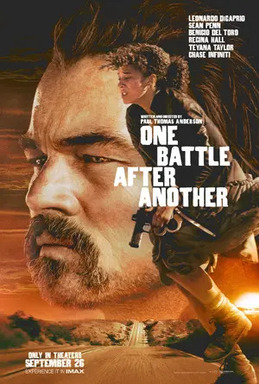
Without watching the trailer, I head to the cinema, not really knowing what to expect from Paul Thomas Anderson’s new movie. And then — surprise — I discover one of the most explicitly political films of his career. One Battle After Another tells the story of the French 75, a fictional anti-fascist group carrying out violent actions against a deeply conservative, capitalist, and anti-immigrant American government. The film follows Bob (Leonardo DiCaprio) and his daughter, Willa (Chase Infiniti), living quietly years after the group’s dismantlement. But are they really safe?
Seeing Anderson tackle such an openly revolutionary story in today’s climate feels almost surreal. The film, released in the U.S. on September 26, has already grossed over $100 million — becoming his highest-grossing movie to date. But beyond its commercial success, it’s a bold political statement. Anderson portrays the Left not as a reformist force trying to win power through elections, but as a disciplined underground movement using violence to make itself heard.
The film unfolds like a frantic — sometimes zany — chase. It features eccentric characters, such as the fanatical and disgusting Steven Lockjaw (Sean Penn), the karate teacher played by the brilliant Benicio Del Toro, and the revolutionary Perfidia, who seems to be turned on by violence, although her appearances are brief. The uniqueness of the characters, combined with a fast-paced chase set to a soundtrack made by Jonny Greenwood himself (yes, the former Radiohead member), works perfectly, so perfectly that its 2-hour and 50-minute runtime flies by almost unnoticed.
But this isn’t truly what I want to focus on here. The most striking aspect of One Battle After Another, in my opinion, is its deeply political dimension. This film feels like an attempt to imagine the aftermath of a revolution whose fire has started to fade. A revolution is defined by movement, disruption, transformation — and in One Battle After Another, Paul Thomas Anderson depicts a post-revolutionary period, where the once bomb-planting Bob has sunk into domesticity and drugs, becoming a junkie-dad overprotective of his daughter.
By choosing to focus on the post-revolutionary moment, Anderson tells us that revolution dies when its fighters stop moving. In the end, the characters don’t get what they want and fail to change the established order. They don’t make the revolution they hoped for; worse, their movement never really takes hold, and everyone often perceives anarchist groups like the French 75 as crazy extremists. The film screams what Gil Scott-Heron once sang: The Revolution Will Not Be Televised — and Anderson ensures we don’t forget it, weaving the song through the film like a warning.
The French 75 operate in the shadows. No phones, no computers, no screens; only overly complicated passwords and impromptu meetups. Their revolution exists solely through action — tangible, physical, human. And this is precisely what Anderson wants us to understand here: nothing will ever change if we all stay glued to our screens. Revolution happens in real life, through concrete actions, through people, through offline contact. It might sound like a bit of a boomer take, but the film fully embraces it — and honestly, I appreciated that. It goes against what we’re used to hearing, especially since we all love our little screens a bit too much.
And finally, when you walk out of the theater, you feel strangely re-energized, motivated, determined — as if the fight isn’t over. Which is paradoxical, since for our protagonists, their mission is far from what we can call a success. Even if the movie is filled with hope, no U.S. government is ever overthrown. And maybe it’s for the best — Paul Thomas Anderson would have been even crazier if he had released a film that actually overthrows the government, especially in such a context: far-right activist Charlie Kirk was assassinated on September 10, and President Donald Trump continues his crusade against anything ‘woke,’ even labelling the Antifa movement a ‘terrorist organisation’ on September 22.
Whether you agree with its politics or not, it’s rare to see Hollywood dare to show the Left with such fire and conviction. In the end, One Battle After Another lands like a Molotov cocktail in the middle of this war against the left, and it was definitely worth the rainy walk to the theatre.