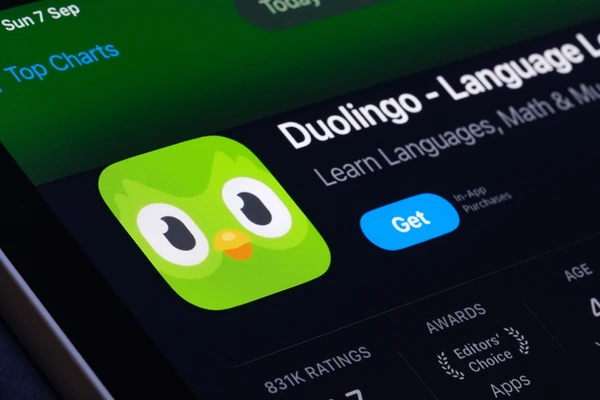
Duolingo is undeniably the most well-known and talked-about language-learning app on the internet. This is in large part due to the abundance of online memes the company has repeatedly positioned itself at the centre of, such as its embrace of users joking about Duolingo threatening their safety if they don’t keep up their streak, or when they announced the death of their mascot as a PR stunt in February 2025, with the clear (and successful) intent of sparking memes and discussion online. It’s obvious that Duolingo knows how to get attention online, but among the language learning community, many are starting to reject the green owl.
Duolingo is well known for its “streak” system, where users are tasked with completing at least one lesson every day to get a larger and larger number. Sold as a way to encourage users to practice their chosen language every day, with the promise of a higher streak bringing higher fluency, it is more likely there as a cynical marketing tactic, to get users to compete with each other and post about their streaks, driving engagement online and increasing traffic for their app, which in turn shores up revenue from ads or subscriptions.
Duolingo openly advertises that “completing seven units of the Spanish or French courses earned reading and listening scores comparable to five university semesters”. When I was younger, I took Duolingo’s promises to heart, and completed the entirety of their Irish language course, expecting that when I finished it, I would have a very high proficiency, but to this day I can hardly speak Irish. This is because of how Duolingo teaches, or rather, how it tricks you into thinking you are being taught. Duolingo has you memorise set words and phrases, but teaches you nothing in context, your brain does not hear the language being used by real people in the real world, and so it has nothing to latch on to, no real world experiences or people to link the language to, and so eventually it fades. Duolingo also gives users no insights into how the grammar of a language actually works, leaving them with only a surface level understanding of grammatical structures. All Duolingo does is train the users to match one sentence to another.
The best and fastest way to learn languages is to follow a study plan where you learn and revise grammar and vocabulary, and supplement that by surrounding yourself with the language, and exposing yourself to it as much as you can to reinforce what you’ve learned. Duolingo can potentially be used alongside this method, but certainly not as the replacement it markets itself as, and a higher streak certainly does not reflect greater command of your language.
Duolingo also sparked controversy in 2025 when it openly embraced the incorporation of generative AI into its app, with the company CEO referring to Duolingo as staunchly “AI first” in a letter posted to his LinkedIn profile. This was followed by 10% of the company’s hard-working human lesson writers being laid off, to make way for more content to be added to the app, without being moderated for quality by humans. Soon after, many users immediately noticed many language mistakes being made by Duolingo, likely as a direct result of the new AI-centred approach of the company.
With unfounded promises of language acquisition, worsening quality and ethical concerns brought about by AI, it’s not surprising that many language learners are moving away from Duolingo. Is it a completely useless tool to help with your language-learning journey? No, but the fact remains clear that mastery over a language requires far more than a big number on your Duolingo streak.