
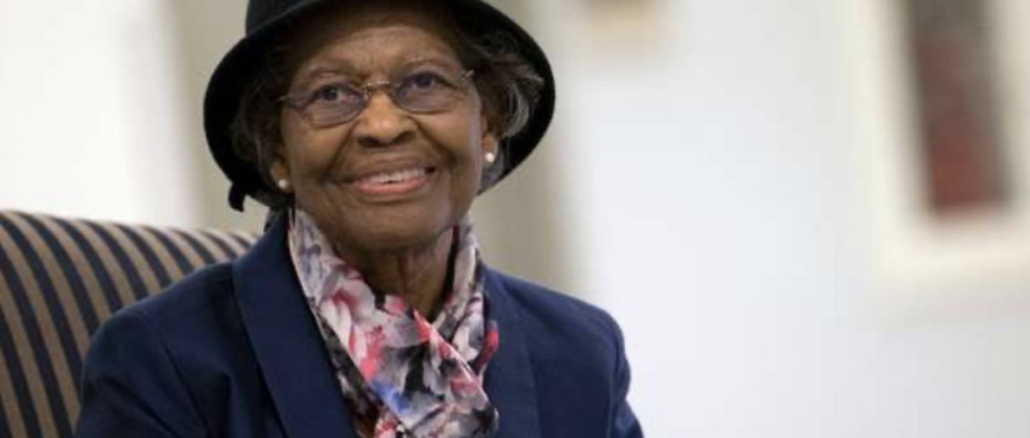
“I felt proud of myself as a woman, knowing that I can do what I can do. But as a black woman, that’s another level where you have to prove to a society that hasn’t accepted you for what you are.”
Mathematician Gladys West was born in Virginia, United States of America, to a farming family. Growing up, she worked jobs in a tobacco factory. As a valedictorian, she received a full scholarship to Virginia State University, where she earned a Bachelor of Science in mathematics in the early 1950s. To obtain her master’s degree, she taught mathematics and science in segregated schools. This was the same year that President Eisenhower banned racial discrimination when hiring for the U.S. Government.
Upon graduating, she was recruited by the U.S. Naval Proving Ground to work in a weapons laboratory in Virginia. She was one of only four Black employees at that time. Her accomplishments and her comprehension of difficult equations allowed her to move from solving equations to programming computers that automated the work. Years later, in 1978, she was named the project manager for Seasat, an ocean-surveillance satellite experiment. This was the first project demonstrating that satellites could be used to monitor oceanographic data.
Following this experiment, she began working on GEOSAT, a satellite designed to create models of the Earth’s surface. West and her team programmed computers to incorporate the different surfaces, tides, and forces acting on Earth’s surface. They subsequently architected their own programme to account for all this data and calculate satellite orbits. This made it possible to create an exact shape of the Earth – a geoid.
That work laid the foundation for the Global Positioning System (GPS). West’s insights were critical to understanding how GPS satellites functioned. The U.S. Department of Defence soon began to develop the GPS, which evolved into the location technology that surrounds us every day.
Margot Lee Shetterly’s 2016 book Hidden Figures documents the pivotal role of Black female mathematicians in the fields of science and technology during the Cold War era. It is only since then that West’s work has received notable recognition, including induction into the US Space and Missile Pioneers Hall of Fame in 2018. She also received the National Museum of the Surface Navy’s Freedom of the Seas Exploration and Innovation Award in 2023. West gained international recognition as the first woman to earn the Prince Philip Medal from the UK’s Royal Academy of Engineering.
Her legacy underpins many innovations in the scientific, computational and mathematical communities. West was an inspiration for those trying to break boundaries. She believed in herself first: “I always felt really responsible for being the best and doing the best that I could,” West once told the Virginia Museum of History and Culture.
Gladys West passed away on the 17th of January in Virginia.