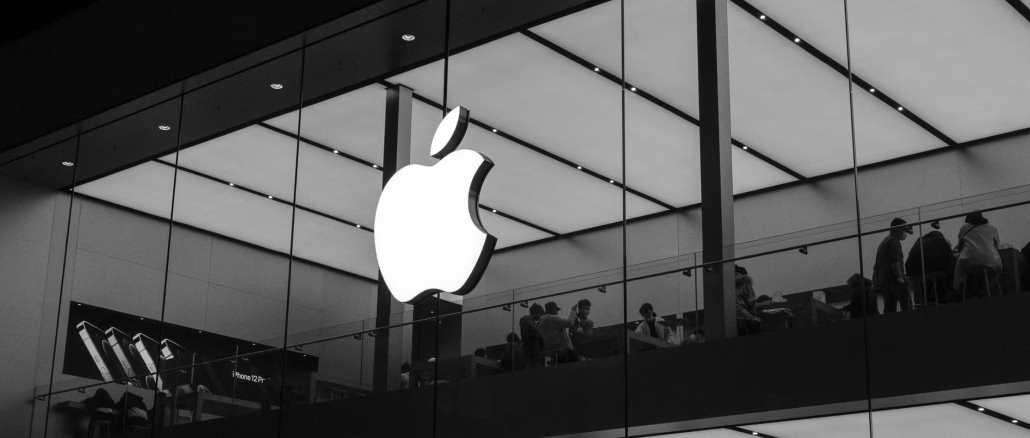
On the 1st of April, it will be 50 years since tech giant Apple was founded in 1976. Steve Jobs and Steve Wozniak set out to create technology that was user-centred and made for consumers. The tech giant mastered the art of computing, changing interfaces and expanding the limits of modern computers. Their products range from the popular iPhone, iPad, and MacBook to smartwatches, headphones, and PCs. In the early 2000s, they launched the iPod, a more modern version of the Sony Walkman with an easy-to-use interface and compact proportions. Thus making the iPod a perfect option for music enjoyers on the go.
In 1976, Steve Wozniak wanted to create his own personal computer while working at Hewlett-Packard. He created a gaming motherboard and showed it to his employers, who were uninterested. Wozniak knew he had something revolutionary and teamed up with his former classmate, Steve Jobs, in a garage to create Apple Inc. Starting a business isn’t easy. Jobs sold his first car, and Wozniak sold his programmable calculator to help fund the start of their company, along with help from an investor, Ronald Wayne, as they journeyed into working capital.
Their first product, the Apple I, was revealed in July 1976. This first product was a motherboard with a very basic CPU, RAM (random access memory) and limited video capabilities; however, it had no monitor or keyboard. It sold for $666.66 and was their first success, after selling just under 200 units in the same year. The following year, Apple II was released and became known as the microcomputer, which sold around five to six million units in the decade following.
The Apple Lisa was released in 1983, and the Apple Macintosh the following year. Both computers had three innovative features. 1. A functional GUI (Graphical User Interface), which was the beginning of what we now see on computers. 2. A pointing device (the mouse), and 3. The use of Icons instead of line commands. These features made the computer more accessible to those who couldn’t code, enabling a broader demographic to be reached.
During the 1984 Super Bowl on January 22nd, their commercial helped make Apple known to many. In the commercial, Apple showed that they were the symbol of innovation by highlighting the George Orwell novel ‘1984’. Their Macintosh was priced at $2,500, accessible to many technical users as well as general consumers. Following this launch, Jobs and Wozniak left for separate reasons, John Sculley becoming the CEO of the company and releasing Mac II and Mac SE, which incorporated colour graphics, the first of its kind. While at Apple, Jobs left Apple and founded NeXT Inc., a computer company that continually innovated, leading to the development of the OS.
In the late 1990s, Apple was consistently underperforming, unable to meet demand and innovate. In 1996, Apple purchased Steve Jobs’ company NeXT Inc. He began to shake up the company and released the first iMac, a minimalistic and accessible computer that could make life easier. Following the launch of the iMac, it quickly became their best-selling product.
In 2001, the company released iTunes, a media player, downloader, and library for music in MP3 format. The success of this allowed them to release the iPod, designed solely for listening to music, replacing the Walkman’s bulky design with a slim, portable one. In 2007, it was reported that over one billion songs had been sold through iTunes.
The touchscreen iPhone was released in 2007, rivalling competitors with keyboards and screens, such as BlackBerry. The phone could play music, use multi-touch features, combine text and email, and create the well-known Apple ecosystem of applications we know. In 2008, the iPhone was compatible with 3G networks and GPS, along with a new operating system (OS) and a 3-megapixel digital camera.
The 2010s brought significant changes to Apple; the first iPad was released, filling the gap between computers and phones. iCloud was introduced for file management and automatically saved media, moving it to other devices on the same shared account with the touch of a finger. Tim Cook replaced Jobs as CEO and still serves in this position at Apple, where he has introduced more products, such as the M1 microprocessors, the Apple Watch, and headphones.
Over the 50 years of Apple Inc., it has led the way in expanding consumers’ access to technology that would otherwise be out of their reach. Computers and phones are now readily available, whereas 50 years ago, this technology was expensive and difficult to obtain. Apple’s impact can be summarised in Steve Jobs’ own words:
“Innovation distinguishes between a leader and a follower.”