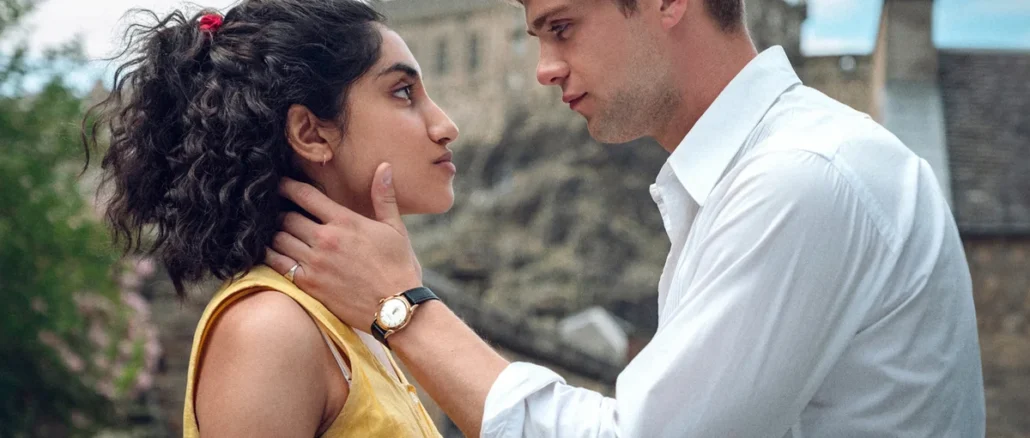
One night at the end of their graduation, Emma and Dexter meet for the first time, in Edinburgh, 1988.
The book One Day, while illustrating a coming-of-age story between the two protagonists, is told through a series of chapters featuring moments they’ve shared across many decades. Emma, clever and witty, meets Dexter, charismatic but rather shiftless regarding his ambitions for life. The two poke fun at each other, and somewhere along the way, become good friends.
In just over 400 pages, David Nicholls manages to grasp his reader from the get-go. Structuring the plot through several flashbacks gives us a sense of who the characters were and who they end up becoming. The series follows the same timeline, where Emma and Dexter meet again and again, at different points in their life.
The two characters play off each other’s banter, which only adds to the realism that the book and series present us with. Two people, who just happened to meet, went from merely strangers to something much more. The storyline highlights the intrinsic detail of ‘timing,’ had it not been for that graduation night, the two would never have met.
One Day, David Nicholls’ 2009 book, has reemerged into public conversation as a direct influence of the success of the 14-part Netflix series adaptation, which premiered in 2024. The multi-million bestselling book has mixed reviews on Goodreads, with some commenting “what a waste of time”, while others were rendered “speechless”.
DCU student Amy Caffrey had only positive things to say about the show: “At times, I forget that they are only characters through a screen. Their chemistry feels real and raw. The anticipation as the series continues is what kept me fully hooked. The ending devastated me and left me shattered. I recommend a watch, and I warn you of a heartbreak”.
DCU student Aimee Donnelly, speaking of the novel, told me that she “loved One Day because it felt so real, the way it showed love not as some perfect fairytale, but as something messy, complicated, and shaped by timing. It made me laugh, cry, and think about how sometimes the right person comes at the wrong time. One line that really stuck with me was “whatever happens tomorrow, we had today”. It just says so much with so little”.
Having seen both the Netflix series and the book, while the series is similar in its portrayal of the characters, it falls short in comparison to the book. Categorised by The Independent as a “romantic comedy,” there are many sequences during the series where an inner monologue would be beneficial to understanding the characters’ relationships and feelings. Furthermore, there were many moments where things were slightly tweaked, and while taking artistic licence is inevitable, the book tells a much more dramatic story.