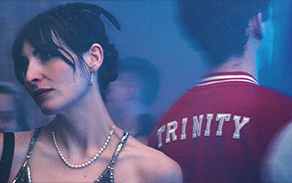
Donnacha Gilmore’s debut feature ‘Girls and Boys’ is a warm, contained tale of a rugby player, Jace, and an aspiring filmmaker, Charlie, who meet at a Trinity College party. From there, they set off on a lover’s odyssey of sorts through a far prettier Dublin than its reality counterpart.
The ‘different worlds colliding’ approach to telling the story of the two characters’ adventure does border on cliché. If you tried to think of two opposites off the top of your head, sports and art stereotypically may come to mind.
While its dramatic finale feels forced and predictable to a certain extent, the film’s melodrama maintains its believability through solid performances from both Liath Hannon and Adam Lunnon-Colley, who play Charlie and Jace, respectively. There is an undeniable, enchanting chemistry between the pair that elevates the audience from the awkwardness, not as cute as the tender beginnings of the tryst.
The aforementioned predictability, in itself, lends a great deal to the flaw of the film- a lack of depth when it comes to telling a hard-hitting story. Visually nostalgic towards a Dublin in deep purple and blues, the film fails to extend its reach past a pastiche of Richard Linklater’s ‘Before Sunrise.’ One of the film’s climactic shots is even a direct nod to the scene in the 1994 film in which we look back on the places that Jesse and Celine have been without their bodies present. The world moves on – that’s the message I always gathered.
However, in ‘Girls and Boys’, the world feels so self-contained that, in fact, the world ostensibly ends when the credits roll. Its space mirrors the setbacks of the adolescents it depicts. There’s only so far it seems it can go, but that is something that Gilmore and the rest of the crew are aware of.
The incorporation of Super 8 is a wonderful nod to the age-old protocol of young filmmakers’ love for the vintage style. The inclusion of the footage between shots in the film, particularly during the party sequence, creates a jarring juxtaposition more than anything else.
What becomes clear as the narrative unfolds is that ‘Girls and Boys’ is a student-led film that appears naive in how much it is trying to say and how much it wants to do in so little time, given its 85-minute runtime.
But in some ways, it’s bigger than a student film. The importance of the film and its representation of Charlie, a trans filmmaker, ultimately earns its place as a new entry in the Irish cinematic zeitgeist rather than achieving such heights for the quality of film itself. In a time where Gilmore himself noted in a recent interview with Hot Press Magazine, “there still haven’t been that many films about the topic, and maybe that’s because there’s a fear around it”, representation becomes more paramount than ever.
In the end, there is no particular triumph, but ‘Girls and Boys’ wears its charming heart on its sleeve through to the finale. It’s a quiet and naive, warm embrace you’re left with as you exit the cinema. You have seen the film for all its flaws but still come out smiling, and in any experience in life, that’s usually a good note to leave on.