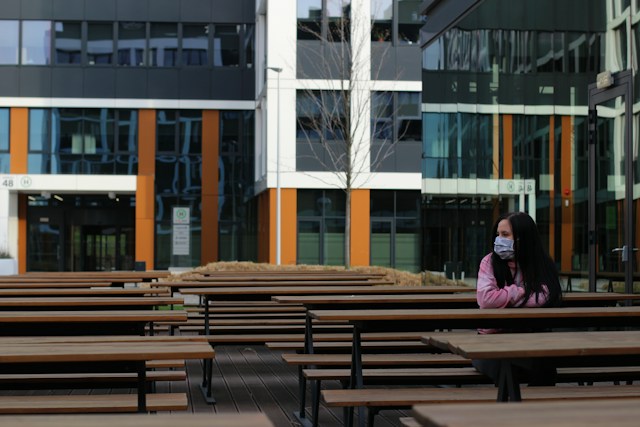
Attending orientation or enduring awkward icebreakers on the first day is a milestone for any new college student, but for the current first-year college entrants , it carries a unique significance. We represent a distinct line in the sand. As the final group of students whose secondary school journey was defined by COVID-19, our introduction to secondary school was shaped by Zoom screens, isolation, and uncertainty. The current 6th years entered under (mostly) normalized routines. For many of us, COVID’s disruption ran so deep that we never even had a proper 6th-class graduation.
According to the Central Statistics Office, approximately three-quarters (76%) of survey respondents who were in secondary school when COVID-19 restrictions were first introduced report that school closures negatively affected their social development.
We all start secondary school around 12 years old, just entering early adolescence. This period is important in shaping who you are, establishing friendships, and gaining vital social skills that will help you throughout secondary school. That valuable time was stripped from us when COVID began.
The Virtual Wall
These lost years are still impacting our day-to-day lives in university; I spoke with fellow first-year students. When asked whether they felt more comfortable being themselves online or in person during that period, the difference in responses was striking.
“I definitely felt — and still feel — more comfortable online,” one student shared. “In person, you are actually being perceived. Online, you can present yourself the way you want to and hide the things you feel self-conscious about.”
In contrast, another student recalled the oppressive nature of virtual connection: “No, I felt extremely uncomfortable online. Silence is so much louder on a screen than in real life. In person, body language breaks up the quiet. To be honest, the second I stopped talking through a screen, I started being myself.”
The adaption
The disruption wasn’t just social; it fundamentally changed how our year group approaches learning today. When asked how remote learning shaped their current study habits in college, one person pointed to practical skills they still rely on.
“It’s definitely given me a skill with typing and being more tech-savvy, in the sense of how we had to use tech for things that would otherwise be done in an analog way,” one student noted.
Others felt remote learning created bad habits that were difficult to shake upon entering university: “Remote learning had zero effect on me now and then because I couldn’t learn. Teachers couldn’t get their feelings across through a screen, and students were too scared to answer anything. If anything, remote learning just made me procrastinate more.”
The Shared Bond
Despite the mixed feelings surrounding academic habits and social anxiety, there was one question in my interviews where the response was unanimous. When asked if there were any positives from that time, every single student agreed that the experience ultimately shaped them for the better.
“It made me who I am today,” one first-year student reflected. Another added: “Every time I meet someone my age, it’s like we have that shared experience — almost a trauma bond in a sense, but a bond nonetheless.”
We may be the last group marked by the COVID-19 school closures of 2020. However, entering university offers something we were denied six years ago: a clean slate. As we navigate this new chapter in our lives, making new friends and joining societies, it’s a small comfort to know we all made it through that shared experience together, from COVID to college.


