
Revisiting the Myth: Del Toro vs the Pop Culture Monster
Green skin, a square head, barely intelligible speech, bolts in the neck, scars everywhere: Frankenstein’s creature has become a true icon of horror. Yet, Mary Shelley barely described the creature’s physical appearance in her 1818 novel. And in his 2025 adaptation, Mexican director Guillermo del Toro gives him an almost human head and an impeccable musculature. An unconditional admirer of Shelley, del Toro deliberately breaks this erroneous myth to present an intelligent, kind and deeply empathetic creature -far from the cliché with bolts in his neck.
With Pan’s Labyrinth (2006), The Shape of Water (2017), Pinocchio (2022) and now Frankenstein (2025), del Toro’s fascination with monsters is undeniable. It is this sensitivity that pushes him to return to the original novel, to detach himself from the clichés that are too deeply rooted in the collective imagination, and to move closer to Shelley’s spirit. The original story follows Victor Frankenstein, a young aristocrat and scientist, who assembles a creature in an experiment that is as brilliant as it is blasphemous. Shelley’s Gothic novel terrifies not through gore, but through atmosphere: dark, gloomy, oppressive. She also describes her creature as ‘hideous’ but leaves the rest to the imagination. Del Toro recreates this atmosphere in his version released at the end of October, even if – I can say it without hesitation – the book gave me far more of a fright than the film. The film is bloodier, but the book is more disturbing. But for once, I found this adaptation surprisingly faithful to the novel’s substance, even though many elements differ.
The Rewriting of the Characters
The first major difference concerns Victor’s childhood. In the novel, he grows up in a loving household with his parents, his brother William and little Elizabeth, adopted by the family and destined to become his wife. The death of his mother – “the first misfortune of my life”, he writes – triggers his insane project to create life. His desire to transcend the limits of mortality already existed, but grief transforms it into obsession. In the film, Victor’s background is entirely different. His father, a renowned doctor, is violent and cold, showing affection only to William. Victor (Oscar Isaac), rejected and beaten whenever he fails to learn quickly enough, develops a visceral need to surpass the father who humiliates him. When his mother dies, he holds his father responsible. It is this trauma – rather than pure scientific ambition – that fuels his desire to conquer death. And I really appreciated this addition.
I also greatly enjoyed what del Toro does with the character of Elizabeth. Far from the passive fiancée of the novel, she becomes in the film a brilliant entomologist, independent and engaged to William. She plays a central role, notably because of her unique relationship with the creature (Jacob Elordi). Whereas in the novel, Elizabeth is killed by the creature – their first and only interaction – in the film, Mia Goth gives the character an almost maternal, tender gaze, as if she instinctively understands what the creature feels. “I’m odd,” she says in the film – a line that becomes a bridge between her and the creature: two beings who don’t fit into any mould. Their bond has an exceptional depth, whether one interprets it as romantic or maternal (the debate is open, but in my opinion, it matters little: their connection simply works). And I love that the film gives depth to a female character who was almost erased in the book. That doesn’t mean Shelley was misogynistic, far from it: her narrative required her to focus all her criticism on masculine hubris and pride.
Another notable difference is the character of Henrich Harlander (Christopher Waltz), invented specifically for the film. Even though Victor seems to completely ignore him, his role is interesting. A wealthy arms dealer, sick and obsessed with prolonging his life, he funds Victor’s experiments in the hope of escaping his own death. It is therefore impossible not to notice a parallel with our contemporary capitalist society and modern transhumanism. Today, the wealthy are obsessed with surpassing the human – through AI, but also through the desire to never age, with anti-ageing products and Botox, for instance. This addition modernises the myth by replacing it in a more contemporary landscape, tying it to our current anxieties.
The Theatre of Flesh: del Toro’s Graphic Creation Scene
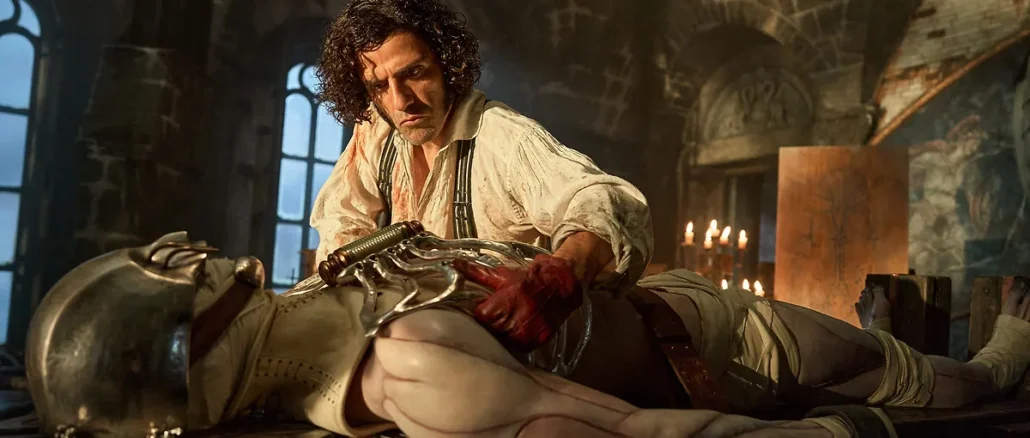
Visually speaking, del Toro hides nothing about the creation: body parts flying everywhere, blood pooling on the floor, the workshop a squalid mess. The creation is extremely graphic and explicit, making the scene so grotesque that it becomes funny – and disgusting. In contrast, in the 1818 version, the creation is much faster, almost abstract: Shelley does not dwell on the process itself, because what truly matters is the idea of creation, the moral transgression.
A Reimagined Moral Core
I won’t discuss the film’s ending here, because I don’t want to spoil it and would rather let you discover it for yourself. However, the most interesting aspect to analyse is the film’s moral basis. Shelley criticised hubris – excessive pride and the desire to play God. And that is exactly what Victor does in the story: he oversteps the sacred boundaries of creation, which, in a deeply Christian England, was considered sacrilegious. His undertaking is not only immoral; it is dangerous, because it exposes the endless nature of scientific progress. In the film, the critique is similar, but it is tinged with something else. Victor appears as the real monster: violent, impatient, cruel towards the creature, reproducing on it the very abuses inflicted by his own father in his childhood. The creature, on the other hand, becomes violent only in reaction. It wants to love and be loved. It learns, feels, and suffers. Through his love of monsters, del Toro humanises the creature profoundly and makes it a ‘victim of the world’. Shelley, on the other hand, portrays a creature that becomes murderous and relentless, to denounce the madness of the creator who dared to defy death. Del Toro, for his part, insists on another moral: hurt people hurt people – violence is born from pain, and the cycle must be broken.
Both versions ask the same fundamental question: who is the real monster? The creature, who never asked to exist, or the creator, consumed by ego or by a tumultuous past?
Final Take: A Very Human Reinterpretation
Ultimately, whether it is Mary Shelley’s gothic horror or Guillermo del Toro’s visual melodrama, I loved both. The 2025 version offers a modern twist to the original work, while preserving the heart of the story. The film is beautiful, moving, and invites us, as viewers, to reflect on the human condition and on humanity’s insatiable desire to know and understand everything. What struck me most, however, was Jacob Elordi’s extraordinary performance. His previous roles, across all kinds of genres, had never particularly moved me. But here, he is magnificent – embodying the character with absolute precision. He truly becomes the creature, not only thanks to ten hours of prosthetics and makeup, but also through an exceptional level of acting.
As a final word, I’d like to address horror film fans: Frankenstein is not a horror film. It is gothic, bloody at times, but above all deeply human. It won’t scare you as much as the novel… but it will make you love the creature and despise the real monster: mankind.