
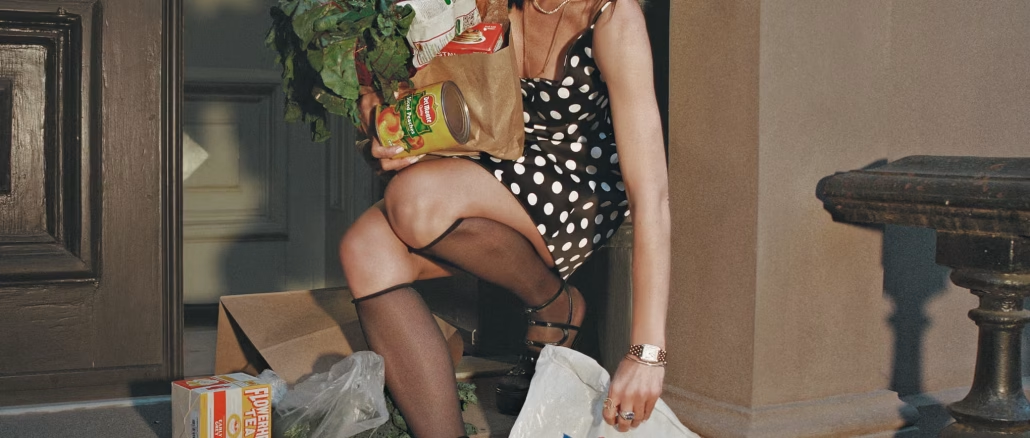
The release of ‘West End Girl’ marks Lily Allen’s return to her idiosyncratic position in the world of pop.
Seven years on from 2018’s ‘No Shame’, Lily Allen returns with a lyrically gobsmacking album that has online discourse spilling over into personal conversations and ruminations over the place art has for the truly personal.
Detailing the unravelling of her marriage to actor David Harbour, Allen pulls no punches in the framing of her ex-husband, while simultaneously not shying away from her own emotions and part to play in a portrait of a marriage so aggressive and yet so tender within the forty-four minutes of ‘West End Girl’. The British singer lays out her life on a canvas.
For as long as art has been around, viewers, listeners and readers have all fancied themselves with deciphering clues surrounding the artist’s real-life inspiration for a work of art. But what if that inspiration itself is the work of art?
Very rarely do artists truly illuminate their lives for the sake of utterly transparent reflection, so for many, this is a breath of fresh air in a world where pop vagueness continues to dominate the lyrical landscape.
Sonically charged by an early 2020s pop synth melody, the eponymous track ‘West End Girl’ sets a faux light-hearted tone for those not listening closely, but breaks that barrier down swiftly with a simulated phone call in the songs final moments in which Allen portrays what sounds like the beginning of strife and neglect within the marriage, her voice trembling as she ends the call as orchestral sounds see us out.
‘Ruminating’, a dance-electro track, is a dynamic shift towards reflection, referencing the aforementioned phone call as a rising frustration emerges. This, alongside the second half of ‘Madeline’ and ‘Relapse’, helps maintain coherent musical consistency. At the same time, songs like ‘Sleepwalking’, ‘Tennis’, and ‘4chan Stan’ remind listeners why Lily Allen is regarded as a pop singer. But, as always, Allen borrows from manifold genres, including bedroom pop, dance, reggae, what sounds like mariachi, and many more, that ultimately construct a sound as messy and as kaleidoscopic as grief itself.
Lily Allen herself noted in an interview with Jonathan Dean in The Sunday Times Culture Magazine that “intimacy is inherently messy”. Intimacy is love and intimacy is death.
In 2016, Phil Elverum, better known by his stage names ‘The Microphones’, then later ‘Mount Eerie’, released the album ‘A Crow Looked at Me’. In the album, Elverum explores grief in such a humane and intense way through imagery of toothbrushes, old sanitary pads still in the bin, a package ordered to the house, all in the wake of his wife’s death.
Although some may conclude that these separate situations cannot be put to comparison, Lily Allen did face the death of her marriage earlier this year. Little things like sex toys, condoms, all inside a pharmaceutical carrier bag, become so surreal and absurd despite being rooted deep in reality as evidence – evidence of the dissipating marriage between Allen and Harbour.
‘West End Girl’ is an album trying to make sense of grief, but stumbling on its way to peace. We don’t know who Madeline is. Then we do. Then we hear her on the phone. We don’t know if she’s having Harbour’s baby, whether or not he held her hand in the soft, intimate ‘Just Enough’. From there, it’s about getting back out there. It’s hard, and Allen hates it, but she’s trying. Though she’s not leaving without a few final jibes in ‘Fruityloop’.
As for public comparison to recent trends in pop music as a space for personal storytelling, Lily Allen isn’t necessarily following in the footsteps of her contemporaries – she’s been doing this since 2006, since the days of ‘LDN’, where old ladies were “struggling with bags from Tesco”. As an artist, Lily Allen regularly employs a conversationally immediate poetic style to her work, now only thrust deeper into the areas of her life that many would hide away in privacy.
The absurdity regarding the lyrics and tonal shifts does sometimes make for comical listening through a natural shock value attributed to the album, yet this is a complex, colourful, and rich narrative that unravels a tale of deceit through the prowess of Allen as a Charles Bukowski-esque storyteller in the industry. Her inspirations and contemporary comparisons are pertinent to conversations about her work, but right now, Lily Allen stands alone.